What Are the Main Types of Ball Valves for Industrial Applications?
Table of Contents
Industrial ball valves fall into five primary categories: floating ball valves, trunnion mounted ball valves, multiport ball valves (3-way, 4-way), V-port ball valves, and segmented ball valves. The right choice depends on operating pressure, flow control needs (on/off vs. throttling), pipe size, and medium characteristics.
I’ve seen too many “wrong valve” replacements in the field. For engineers, system designers, and project managers, we will explain each type in plain language, compare their features, and provide a practical selection framework in this article.
How Does a Ball Valve Work?
A ball valve uses a spherical ball with a bore (hole) through its center. Rotating the ball 90 degrees opens or closes the flow:
- Open position: The bore aligns with the pipe axis, allowing fluid to pass through.
- Closed position: The solid part of the ball faces the flow, blocking it completely.
Sealing is achieved by pressing the ball against soft or metal seats. In floating designs, fluid pressure pushes the ball into the downstream seat. In trunnion designs, fixed supports absorb the pressure, and springs push seats onto the ball (that one mechanical difference changes everything about where you can use the valve).
Ball valves offer quick quarter-turn operation, reliable shut-off, and low pressure drop when fully open.
Ball Valve Primary Classification: By Body Design and Ball Support
Floating Ball Valve
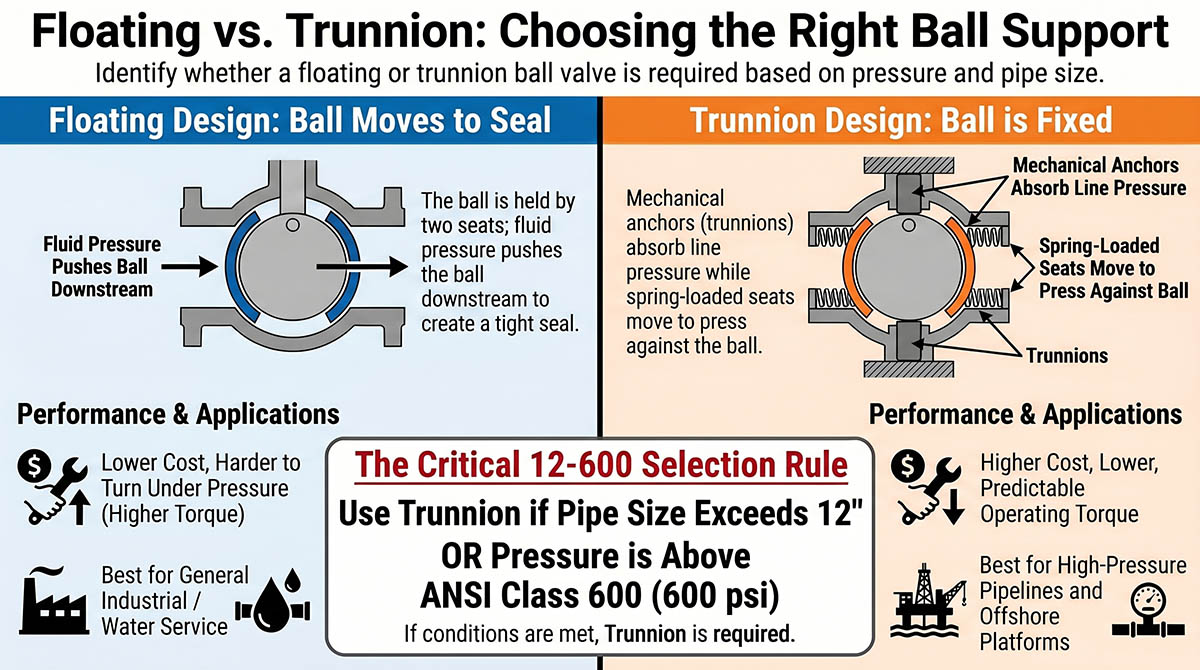
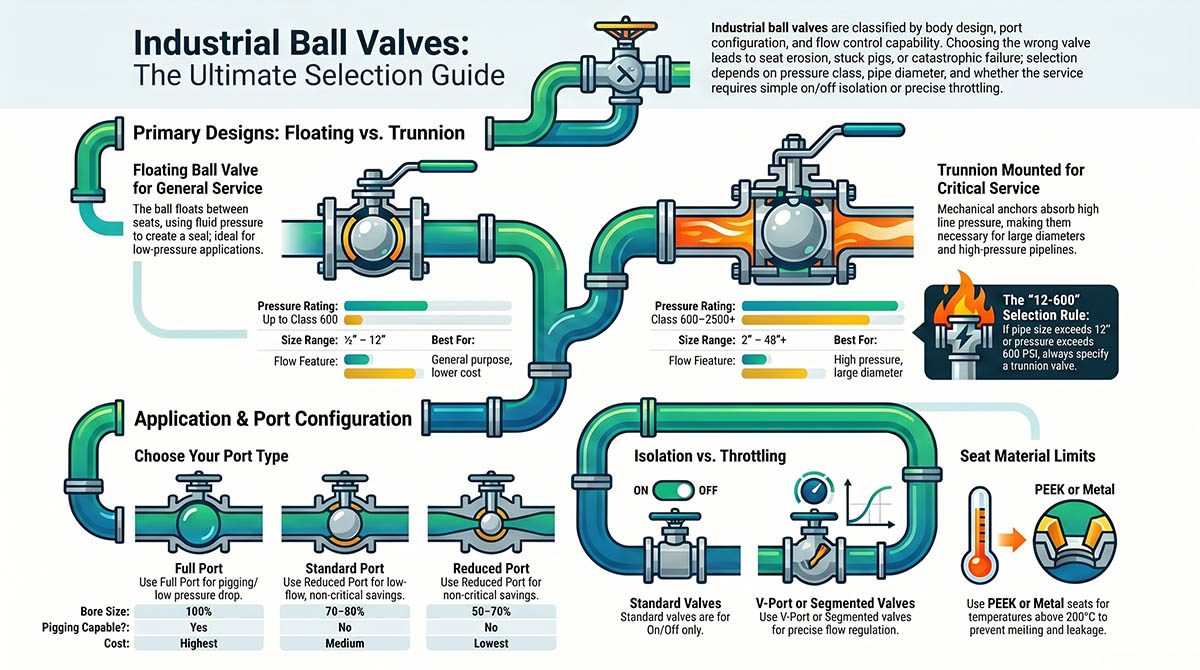
In a floating ball valve, the ball is not fixed in place. The ball “floats” between two seats. When fluid pressure enters the valve, it forces the ball against the downstream seat, creating a tight seal.
Characteristics:
- Suitable for low to medium pressures (typically up to ANSI Class 600)
- Available in sizes from ½” to 12″ (smaller sizes preferred)
- Lower torque than trunnion designs
- Simple construction, lower cost
You can place it for:
- Water treatment
- Low-pressure oil & gas (up to 600 psi)
- HVAC skids
- General industrial on/off service
Trunnion Mounted Ball Valve
A trunnion ball valve has mechanical anchors (trunnions) at the top and bottom of the ball. These trunnions absorb line pressure, so the ball does not push against the seats. Instead, spring-loaded seats push onto the ball.
Characteristics:
- High-pressure capability (Class 600 to Class 2500 and higher)
- Available in large diameters (up to 48″ or more)
- Lower operating torque (seats do not rub the ball under pressure)
- May include double block & bleed capability
It’s widely used in:
- Long‑distance pipelines
- Refinery catalyst lines
- High‑pressure hydraulic systems
- Offshore platforms
Comparison Table – Floating vs. Trunnion Ball Valves
| Feature | Floating Ball Valve | Trunnion Ball Valve |
|---|---|---|
| Pressure rating | Low to medium (up to Class 600) | High to very high (Class 600–2500+) |
| Size range | ½" – 12" | 2" – 48" or more |
| Ball support | No fixed support; pressure pushes ball into seat | Top and bottom trunnions fix ball position |
| Seat design | Seat is stationary; ball moves | Seat is spring-loaded; ball fixed |
| Operating torque | Higher at high pressure | Lower, more predictable |
| Cost | Lower | Higher |
| Best for | General purpose, moderate conditions | High pressure, large diameter, critical service |
One number to remember: If your line size >12″ or pressure >600 psi, stop thinking about floating. Go trunnion.
Ball Valves Classified by Port Configuration
Port configuration refers to the size of the ball bore relative to the pipe inner diameter.
Full Port (Full Bore)
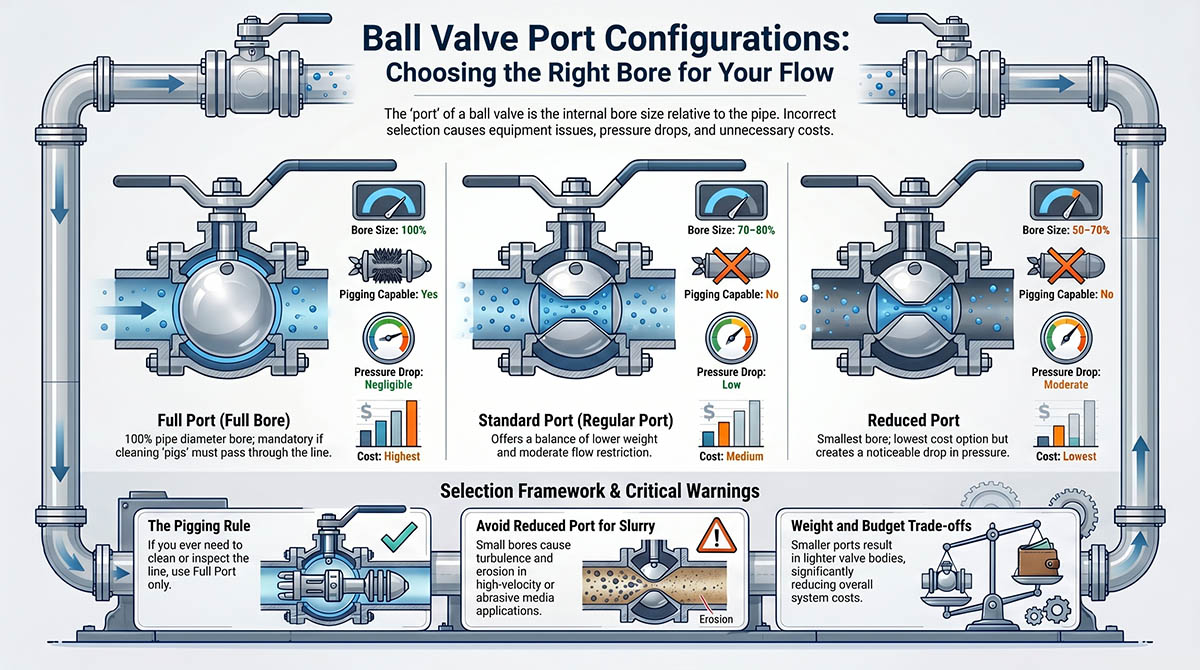
The ball’s bore is the same size as the pipe’s inner diameter. No flow restriction. No drop in pressure and the ability to pig (clean the pipeline); but it’s more expensive with a bigger valve body and weighs more. When to use: Pigging is needed and a small drop in pressure is important.
A client ordered reduced port ball valves for a crude oil line that needed monthly pigging. Result: the pig got stuck, and they had to cut the pipe. Full port was the only answer.
So ask yourself: Will you ever send a cleaning or inspection pig through that line? If yes, full port is mandatory. Period.
Standard Port (Regular Port)
The ball bore is approximately 70–80% of the pipe diameter.
It has a smaller body, it’s cheaper & lighter. But it features some pressure drop, and it doesn’t allow pigging. So use it when pigging isn’t needed and cost and weight are important.
Reduced Port
The ball bearing is much smaller than the pipe diameter, usually by one pipe size. Among the three type port, this one has the smallest body size and lowest price. But it does has a noticeable drop in pressure, which could cause turbulence or erosion in slurry service. So we advise you to use it when the flow rate is low and the application is not critical.
| Port Type | Bore Size vs. Pipe ID | Pressure Drop | Pigging Capable | Cost |
|---|---|---|---|---|
| Full port | 100% | Negligible | Yes | Highest |
| Standard port | 70–80% | Low | No | Medium |
| Reduced port | 50–70% | Moderate | No | Lowest |
Specialized Ball Valves for Flow Control and Multi-Directional Alternations
Standard ball valves are terrible for throttling. The flow characteristic is too steep – you open a little, nothing happens; then you open a bit more, and flow jumps to 80%. That’s called “quick opening” characteristic, and it’s useless for regulation.
Multiport Ball Valves (3-Way, 4-Way)
Multiport valves have three or four ports, allowing flow diversion, mixing, or direction changes.
Common configurations:
- L-port: Connects adjacent ports. Rotate 90°, and you switch flow from one outlet to another.
- T-port: Connects any combination of two or three ports – used for mixing or full shut-off.
Applications: Tank switching, sampling systems, bypass lines, heating/cooling circuits.
Advantages: Replaces multiple valves, reduces fittings and leak points.
V-Port Ball Valve
The ball has a V-shaped notch (or multiple V-notches) machined into its surface. As the valve opens, the V-notch creates a controlled flow area.
Characteristics:
- Provides nearly equal percentage flow characteristic – small opening changes have proportional flow effect.
- Good for throttling and flow regulation.
- Higher rangeability than most other control valves.
Applications:
- Steam control
- Slurry flow regulation
- Paper stock flow
- Chemical dosing
- Tank level control loops
Not suitable for: Abrasive media at high velocity (V-notch erodes) or tight shut‑off (the notch will always pass a tiny flow).
Segmented Ball Valve
A segmental ball valve uses a partial ball (often 60–90 degrees of a sphere) instead of a full sphere. Like a V-port, it is designed for control.
Characteristics:
- Lighter and smaller than full-ball control valves.
- Less tendency to pack with solids.
- Often used in pulp and paper, wastewater treatment.
Key Features of Different Ball Valve Type Quick Comparison
| Type | Size Range | Pressure Class | Primary Use | Key Advantage | Key Limitation |
|---|---|---|---|---|---|
| Floating | ½" – 12" | Up to Class 600 | On/off for general service | Simple, low cost | Not for high pressure or large size |
| Trunnion | 2" – 48"+ | Class 600–2500+ | High pressure, large pipelines | Handles high pressure, low torque | Expensive, heavy |
| Multiport (3/4-way) | ½" – 12" | Up to Class 600 | Flow diversion, mixing | Replaces multiple valves | Limited size range |
| V-port | 1" – 20" | Up to Class 600 | Throttling, flow control | Smooth, equal percentage characteristic | V-notch erodes |
| Segmented | 2" – 24" | Up to Class 600 | Throttling for slurries | Resists packing, lighter | Less precise than V-port |
How to Choose the Right Type of Ball Valve – A Practical Checklist
Use this numbered checklist for selecting ball valves:
- Determine the function – On/off isolation or throttling/control?
- On/off → Floating or trunnion
- Throttling → V-port or segmented
- Check pressure rating – Operating pressure and potential surges.
- Low/medium → Floating ball valve
- High → Trunnion mounted
- Measure pipe size – Diameter and connection type (flanged, threaded, welded).
- Small (≤12″) → Floating possible
- Large (>12″) → Trunnion required
- Need pigging? – Yes → Full port only.
- Need multiple flow paths? – Yes → multiport 3‑way or 4‑way..
- Consider maintenance – Floating valves are easier to repair in smaller sizes; trunnion valves often have replaceable seat cartridges.
- Evaluate medium – Corrosive? Abrasive? High temperature? Clean → PTFE seats / Abrasive or high temp → metal seats / Fibrous → segmented ball valve.
- Fire‑safe required? – Yes → demand API 607 or ISO 10497 certification.
- Check budget
Common Body and Ball Materials for Industrial Applications
Valve body and ball material decisions will outlive your project. Get them wrong, and corrosion or temperature will kill the valve in weeks.
Body materials (select based on fluid compatibility and temperature):
| Carbon steel (WCB) | Low (needs coating) | -29°C to 425°C | Oil, gas, steam |
|---|---|---|---|
| Stainless steel (CF8/304) | Good | -196°C to 400°C | Corrosive fluids, food, chemical |
| Stainless steel (CF8M/316) | Very good | -196°C to 400°C | Marine, acid service |
| Brass | Moderate | -20°C to 150°C | Water, air, low pressure |
| Alloy (Hastelloy, Monel) | Excellent | Cryogenic to high | Aggressive chemicals |
Ball surface: Chrome-plated (standard), stainless steel, ceramic (abrasive service), Stellite (high temperature, wear).
Seat materials:
| Seat | Max temp | Wear resistance | Best for |
|---|---|---|---|
| PTFE | 200°C | Low | General service, clean media |
| RTFE (reinforced) | 200°C | Medium | Higher pressure, some solids |
| PEEK | 260°C | High | High temp, chemically aggressive |
| Metal (Stellite, Inconel) | 650°C | Very high | High temperature, fire safe, abrasives |
Industry-Specific Use Cases
| Industry | Common Ball Valve Type | Reason |
|---|---|---|
| Oil & gas pipelines | Trunnion, full port | High pressure, need pigging, fire-safe |
| Chemical plants | Stainless steel floating, V-port | Corrosive media, precise control |
| Water/wastewater | Floating, full port (large diameter) | Low pressure, low cost, pigging for cleaning |
| Tunnel fire protection | Trunnion, metal-seated | High reliability, fire-safe design |
| HVAC | Brass floating, standard port | Low cost, moderate pressure, frequent operation |
| Pharmaceutical | Stainless steel sanitary floating | Cleanability, no dead legs |
| Pulp & paper | Segmented, V-port | Handles fibrous slurries, resists clogging |
Common Mistakes When Selecting Ball Valves
Mistake 1: Choosing reduced port when pigging is required
Pig gets stuck. Emergency shutdown. Call a welder. Remember to always specify full port if pigging is even a future possibility.
Mistake 2: Throttling with a standard ball valve
Result: Seat erosion, poor control, premature failure.
Solution: Use V-port or segmented ball valve for throttling.
Mistake 3: Ignoring seat material temperature limits
“But PTFE is cheap!” Then it melts at 250°C, leading to leakage. Thus we recommend to select metal or PEEK seats for high temperature.
Mistake 4: Wrong installation orientation
Some trunnion valves have a preferred side – read the manual.
Mistake 5: Overlooking fire-safe requirements
For hydrocarbon service, fire‑safe certification (API 607) is not optional. Standard valves may not meet this.
Mistake 6: Specifying floating valve for very high pressure or large diameter
Result: Excessive torque, potential seat damage. Use trunnion instead.
FAQ
Conclusion
Selecting the correct type of ball valve requires understanding your application’s pressure, size, control needs, and medium. Floating ball valves suit general low-pressure duties; trunnion valves handle high-pressure pipelines; multiport valves simplify flow switching; V-port and segmented valves enable precise throttling.
Need high quality ball valves for your project?
As your reliable industrial valve manufacturer and solution provider, Ball Valve Technology machines and assembles floating, trunnion, V‑port, segmented, and multiport ball valves in carbon steel, stainless (304/316), and duplex alloys. Our engineers can help you select the right type, size, and seat material for your industrial application. We provide full certifications: API 607, ISO 10497, PED, CRN.
Contact us at [email protected] for a quote, CAD drawings, or custom-engineered solutions. Tell us your pressure, temperature, media, and pipe size. Our technical sales team will reply with a type recommendation, CAD drawing, and a quote that works for your budget.

With nearly 20 years of full-cycle valve industry experience – from metallurgy to intelligent control – Steven drives industry standards. He excels in high-level design for water and petrochemical projects, builds engineering team capabilities, and delivers reliable, efficient, cost-effective valve solutions to all industrial end-users.