OEM / ODM / Private Label
Custom Butterfly Valve Manufacturer
Butterfly valves excel in precise flow regulation and large-diameter control with compact, lightweight design. We supply resilient-seated, high-performance, and triple-offset butterfly valves for demanding systems.
Our range includes wafer, lug, and double-flanged connections. Body materials: ductile iron, stainless steel, duplex. Seat options: EPDM/NBR (water), PTFE (chemicals), metal (high-temp).
Trusted by system integrators across water treatment, HVAC, chemical processing, power, and marine. API 607 fire-safe, ISO 15848 low-emission, and ISO 5211 actuator mounting available.
OEM & custom-branded solutions with fast lead times and full technical data packages.

Our Butterfly Valve Categories

Wafer Butterfly Valves
Compact and economical, fits between pipe flanges. Ideal for HVAC, water treatment, and general industrial service.
- Wafer‑type design
- Concentric
- Rubber or PTFE lining
- Sizes DN40–DN1200
- Pressure up to PN16

Lug Butterfly Valves
Threaded inserts allow removal of downstream pipe without draining the system. Suitable for blow‑off lines, maintenance sections, and end‑of‑line service.
- Lug‑type ends
- Concentric or double offset
- Body: cast iron, ductile iron, WCB, stainless steel
- Pressure up to PN40

Double Flanged Butterfly Valves
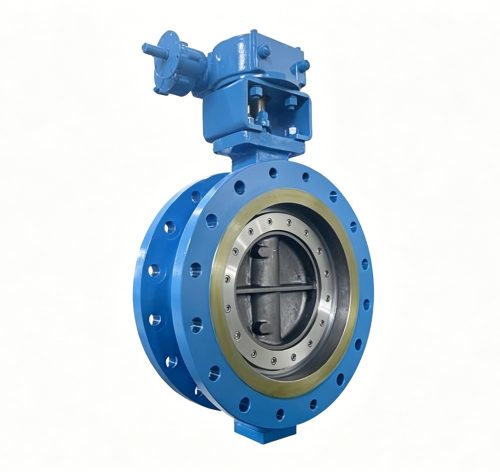
Flanges on both ends for direct bolting to pipe flanges. Recommended for large diameters and higher pressures.
- Double flanged connection
- Concentric or double offset
- For DN300 and above
- Pressure PN40 and up
- Typical for pump discharges and long pipelines

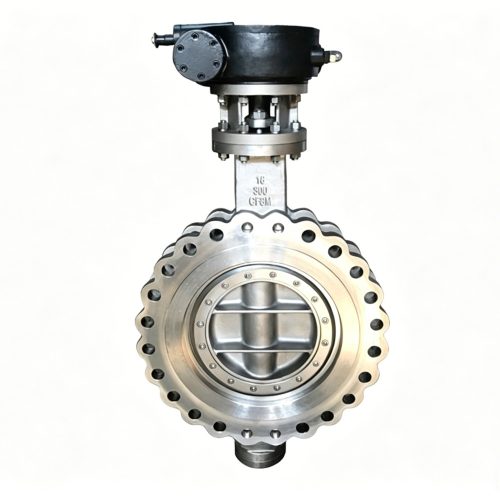
Triple Offset Butterfly Valves
Metal‑to‑metal sealing with zero leakage. Designed for high temperature, cryogenic, and fire‑safe applications.
- Triple offset design
- Metal seat
- Temperature range –196°C to +650°C
- Pressure Class 300 to 600
- Fire‑safe option API 607
- Replaces gate or globe valves

High Performance Butterfly Valves
Double offset design with PTFE or metal seat. Better pressure rating and longer seat life than concentric valves.
- Double offset
- PTFE or metal seat
- Higher pressure rating
- Suitable for petrochemical, steam, chilled water
- Class 150 to 600

Rubber or PTFE Lined Butterfly Valves
Full lining of EPDM, NBR, Hypalon, or PTFE for corrosion resistance. Common in chemical, plating, and water treatment plants.
- Full lining inside body
- Wafer type, economical
- Corrosion resistant
- Temperature from –10°C to +200°C
Key Technical Specifications of Butterfly Valves
| Parameter | Value / Range |
|---|---|
| Size Range | DN40 – DN2000 /1.5" – 80" |
| Pressure Ratings | PN6 / PN10 / PN16 / PN25 / PN40; ANSI Class 150 / 300 / 600 (high‑pressure options available) |
| Design Standards | API 609, EN 593, ISO 5752, MSS SP-67, ASME B16.34 |
| Face‑to‑Face Dimensions | ISO 5752 Series 20 / 25; EN 558‑1 Series 14 / 16 / 20 / 25; API 609 Table 1 |
| Leakage Tightness | ISO 5208 Rate A (zero bubble); API 598 (shell, seat & backseat tests) |
| Fire‑Safe (Optional) | API 607 (4th / 5th / 6th edition); ISO 10497 |
| Low Emission (Optional) | ISO 15848 (fugitive emissions) |
| Top Flange Interface | ISO 5211 – direct mounting for pneumatic / electric actuators |
| Temperature Range | -29°C up to +500°C (high‑temperature version available) |
| Pressure‑Temperature Rating | According to ASME B16.34 or EN 1092‑2 |
Products Filtered By Attributes
Industries & Use Cases – Butterfly Valves
| Industries & Use Cases – Butterfly Valves | |
|---|---|
| Industry | Recommended Valve Type & Key Selection Points |
| Water Treatment & HVAC | Concentric, EPDM seat, wafer type, PN10-16. Quick shutoff, low cost, minimal pressure drop. |
| Oil & Gas / Refinery | Double or triple offset, metal seat, fire‑safe API 607, lug type, Class 150‑300. Handles high temperatures and corrosive hydrocarbons. |
| Chemical & Petrochemical | PTFE‑lined, double offset, alloy materials, ISO 15848 low emission. Excellent chemical resistance and fugitive emission control. |
| Power Generation | Triple offset, metal seated, Class 300‑600, high‑temperature construction. Designed for steam isolation and high cycle life. |
| LNG / Cryogenic | Triple offset, extended bonnet, low‑temperature materials (LCC/LT1), ISO 28921. Suitable for -196°C up to +80°C. |
| Marine & Offshore | Lug type, double or triple offset, NACE MR0175, API 607 fire‑safe. Meets IMO requirements, bi‑directional bubble‑tight shutoff. |
| Pulp & Paper / Slurry | Double offset, wear‑resistant metal seat, large flow passage. Built to resist abrasion and handle fibrous media. |
| Food & Pharmaceutical | Sanitary design, Ra ≤ 0.4μm surface finish, PTFE/EPDM seat, 3A certified. Hygienic, easy to clean, no dead zones |
How to Choose Butterfly Valves?
Concentric
- Frequent cycling: use EPDM and NBR. Chemicals: use PTFE.
- Disc rubs the rubber seat. For water, air, low pressure. Low cost. Max PN16, or Class 150.
Double offset
- Stem is behind and aside the disc.
- Up to PN40, or Class 300, 350°C (metal seat).
- And it can be used in oil & gas, chemicals, steam.
Triple offset
- 3rd angle on seat cone; disc touches only when fully closed.
- Metal-to-metal, zero leakage.
- Capable of 650°C high temp with -196°C cryogenic, and fire-safe.
How it connects to the pipe?

Seat Material

Find the perfect butterfly valve seat material for your application. View specifications for EPDM, NBR, PTFE, and durable metal seats.
Frequently Asked Questions
Every single valve gets tested. Not just one from the batch – every piece. Here’s what that means:
Basic pressure tests (every valve):
Shell test at 1.5× rated pressure – we pump water in and look for any sweat or drip from the body. Then seat leakage test per ISO 5208 Rate A – zero bubbles for soft seats. For triple offset metal seats, we allow a tiny weep but still measure it. Also a low-pressure pneumatic test at 0.6 bar, because sometimes a valve seals fine under high pressure but leaks when the pressure is low. That catches bad seat finishing.
Then we check the mechanical stuff:
Operating torque – we measure how many Newton meters it takes to turn the disc. If it’s too stiff or too loose, we adjust or reject. Dimensional inspection – flange bolt hole alignment, ISO 5211 top flange flatness, face-to-face length. Visual inspection for casting defects, paint scratches, or loose nameplates.
If you order something special (not every order):
Fire-safe test per API 607 – we actually burn the valve in a furnace, then cool it and test again. That’s not on every valve, but we do it on the first piece from each batch and provide a witness report. Cryogenic test for LNG service – we soak the valve in liquid nitrogen at -196°C and cycle it. Cycle life test – open and close the valve 5,000 or 10,000 times to see when the seat starts to leak. Some customers ask for that on high-cycle applications like automated lines.
Material verification (we do this on random samples from each cast):
PMI – a handheld gun checks the alloy chemistry. Hardness test on the disc and stem. Sometimes we pull a coupon for tensile strength. For stainless steel and duplex, we do intergranular corrosion test. And if your spec calls for NDT, we can do radiographic (X-ray) on the casting or ultrasonic on the welds. Magnetic particle or dye penetrant for surface cracks. That’s usually for high-pressure or critical service valves.
What about cavitation or pressure drop?
Those are design tests, not production tests. We’ve done them during development – we have the curves in our datasheet. We don’t run cavitation tests on every valve because it’s destructive and expensive. But if your project needs verification, we can do it as a one-off.
Bottom line: every valve leaves the shop with a signed test report. If you want to see a specific test – say, the burn test video or the PMI printout – just ask. We’ll send it.
Standard sizes (DN50-DN600, cast iron or WCB, EPDM): 15-25 working days. Large or special alloys: 30-45 days. Rush orders on common sizes: 7-10 days possible. Extra charge, but we’ve done it.
Standard valves go down to -29°C. For LNG (-162°C) or liquid nitrogen (-196°C), you need triple offset with extended bonnet and low-temp materials (LCC/LT1). We’ve done it for LNG terminals. Lead time is longer – about 8–10 weeks. Just tell us your temperature.
Quick rule: EPDM for water and HVAC. NBR for oil and fuel. PTFE for chemicals – almost anything except high pressure. Metal seat for steam, high temp, or abrasive media. Still not sure? Send us your fluid and temperature. We’ve seen it before.
Yes, ISO 5211 top flange is standard on all our butterfly valves. Any brand of actuator bolts on directly – no adapter plate. Common sizes: F05, F07, F10, F12, F14, F16. Tell us your actuator model and we’ll confirm.
Yes. Double and triple offset series with API 607 (5th or 6th edition) and ISO 10497. We actually burn-test them and provide the report. Not just a stamp on a datasheet.
Most concentric and double offset are bi-directional. Triple offset usually has a preferred direction – we mark it with an arrow. If you need bi-directional triple offset, ask. It’s possible but costs a bit more.
Concentric – disc rubs against the seat the whole way. Cheap, works for water and air.
Double offset – disc lifts off the seat as it turns. Less wear, higher pressure, longer life.
Triple offset – metal seat, zero leakage, handles steam and cryo. Costs more but replaces a gate valve in tough services.
We provide three mainstream actuation options: manual, pneumatic and electric. Lever operators are fitted for small-size valves; worm gear operators are used for large-bore and high-torque butterfly valves. Pneumatic actuators deliver fast on-off action, which is widely used in industrial automatic control systems. Electric actuators are perfect for sites requiring precise flow adjustment.
Butterfly valves can be used for both full shut-off and flow throttling regulation.
Concentric and double offset butterfly valves achieve excellent throttling performance, widely used for flow control of water, air, slurry and other media.
Continuous operation under 15%~20% opening position is not recommended, as it may cause pipeline vibration and accelerate seal damage.
Triple offset butterfly valves are preferred for flow regulation under high temperature and harsh working environments.
Lug type and flanged butterfly valves are better for dead-end pipeline installation of their safety.
Standard wafer butterfly valves are merely clamped by pipe flanges and cannot be independently mounted at pipeline ends, thus not applicable for dead-end service.
Lug butterfly valves allow downstream pipeline disassembly without draining pipeline media.
Flanged connection provides the highest structural rigidity, which is the optimal option for high-pressure dead-end pipeline applications.
Yes, customized production is available.
We provide butterfly valves made of duplex steel, super duplex steel, Hastelloy alloy and titanium alloy, perfectly suitable for strong corrosive media and seawater service.
We also accept orders for non-standard pressure class valves. Technical confirmation is required in advance, and customized products need longer lead time. Please send us detailed technical parameters for production feasibility assessment.
Small wafer butterfly valves are priced from USD 10 to USD 100. Large bore triple offset flanged butterfly valves cost USD 100 to USD 1000 or above. Additional actuator installation costs an extra USD 100 to USD 2000.
Valve prices are determined by valve type, nominal size, material and actuation type. Low-cost options include small concentric wafer butterfly valves with cast iron body and rubber seat, while large bore high-pressure WCB metal-seated triple offset valves cost much more. The extra cost of pneumatic and electric actuators varies by technical specifications. Please provide detailed parameters including size, pressure rating, material and actuation type to get an accurate quotation.
Valve body materials: Cast iron, ductile iron, WCB carbon steel, CF8 stainless steel, CF8M stainless steel.
Seat materials: EPDM, NBR, PTFE, stainless steel-graphite composite metal seal.
We can manufacture butterfly valves in all above material grades. You may refer to our material selection guide to match proper body and seat materials according to actual working conditions.
Their core difference lies in the offset design of the stem, disc and seat, which determines their service scope and temperature adaptability for ordinary water supply up to severe high-temperature working conditions.
Concentric Butterfly Valve
Its stem, disc and seat share the same central axis. The disc keeps contacting the seat throughout opening and closing movements, leading to gradual abrasion in long-term service. Cost-effective in price, it is mainly used for low-pressure and normal-temperature services such as water and air. Its maximum working temperature is around 93℃, widely used in HVAC, water treatment and agricultural irrigation.
Double Offset Butterfly Valve
The stem is offset backward and sideways. The disc separates from the seat right upon opening and only makes contact with the seat at full closed position. This design greatly reduces friction loss, extends service life and lowers operating torque. Soft-seated types can withstand up to 260℃, and metal-seated versions support higher temperatures. They are extensively used in chemical plants, refineries and marine piping systems.
Triple Offset Butterfly Valve
Based on double offset structure, it adds a conical angular offset on the seat. This design ensures complete separation between disc and seat when open, with sealing only achieved at the final closing stroke. Adopting metal-to-metal sealing, it delivers bubble-tight zero leakage performance with nearly zero wear. Depending on material selection, its working temperature ranges from -184℃ to 650℃. It is the ideal choice for strict services such as steam, high-temperature oil & gas and LNG delivery.
A butterfly valve is a quarter-turn valve that regulates fluid flow via a rotating disc. It features compact structure, light weight and quicker operation than gate valves. And can handle both flow isolation and flow regulation.
A rotatable central disc is fitted inside the valve body. The valve can be fully opened when the disc is parallel to fluid flow. Rotating it 90 degrees to the closed position allows the disc to press tightly against the seat. Its quarter-turn actuation enables faster opening and closing compared with multi-turn gate valves and globe valves.
Butterfly valves are widely applicable for lightweight and space-saving. For the same pipe size, a butterfly valve is 30% to 50% lighter than a gate valve. And our company provides butterfly valve from 1 inch to 120 inches.
Butterfly valves suit for most industrial media including water, oil, gas and steam, and are commonly applied in cooling water systems, HVAC systems, fire protection systems, chemical processing and power plant auxiliary systems.
Nevertheless, butterfly valves have one drawback: the disc stays inside the flow passage even when fully open, so they have some minor pressure drop. If your industy require minimum flow resistance, then I would suggest our company’s full bore ball valves or gate valves.
| Stage | Procedure | Description |
|---|---|---|
| Before Production | PMI (Positive Material Identification) test | Raw material verification |
| In-Production | Dimensional checks | At critical machining stages |
| Post-Production | High-pressure hydrostatic shell test (1.5× rated pressure) Low-pressure air seat test (0.6 MPa) to verify shut-off Optional tests: helium leak test (ISO 15848), fire-safe test, or cryogenic test | Final assembly testing |
| Quality Inspection | Marking verification, coating/painting thickness measurement, and preparation of traceable test reports | Visual & documentary check |
All test records are archived for a minimum of 10 years and can be provided with each shipment. Or you can specify any third-party test institutions.
Our manufacturing facility is certified to ISO 9001:2015 for design, production, and after-sales service of industrial valves. Additionally, we hold ISO 14001:2015 (environmental management) and ISO 45001:2018 (occupational health and safety). All our ball valves for the European market comply with PED 2014/68/EU, and we can supply valves with ATEX certification for explosive atmospheres upon request. Our quality system is audited annually by third-party notified bodies.
Absolutely. For standard ball valves, we can offer off-the-shelf samples of common sizes (1/2″ to 4″) at a discounted price, with a refundable deposit that can be credited toward a future bulk order. For custom or larger sizes, we accept small trial orders (as few as 2–5 pieces) after a non-recurring engineering (NRE) fee is agreed. The NRE fee will be waived once the customer proceeds to a production order of 50 pieces or more.
We offer flexible payment terms based on order value and customer history. For standard orders: 30% deposit by T/T (wire transfer) with 70% balance before shipping. For larger or repeat customers, we can consider 20% deposit + 80% balance payment.
- For standard models, the minimum order quantity (MOQ) is usually 100 pieces per size. For sizes that are in stock, it takes 3 to 5 business days to ship after you place your order. Our usual lead time for making standard catalog valves that aren’t in stock is 15 to 25 business days after we get your order and approve the drawing.
- Custom models (with special materials, pressure classes, actuator mounting, custom logos, etc.): The minimum order quantity (MOQ) varies, so please get in touch with our sales team for a full quote. The lead time is usually 15 to 45 days, depending on how complicated the process is. Also, we offer a mixed-model consolidation service for distributors to help them deal with their inventory problems.


.