Test Purpose
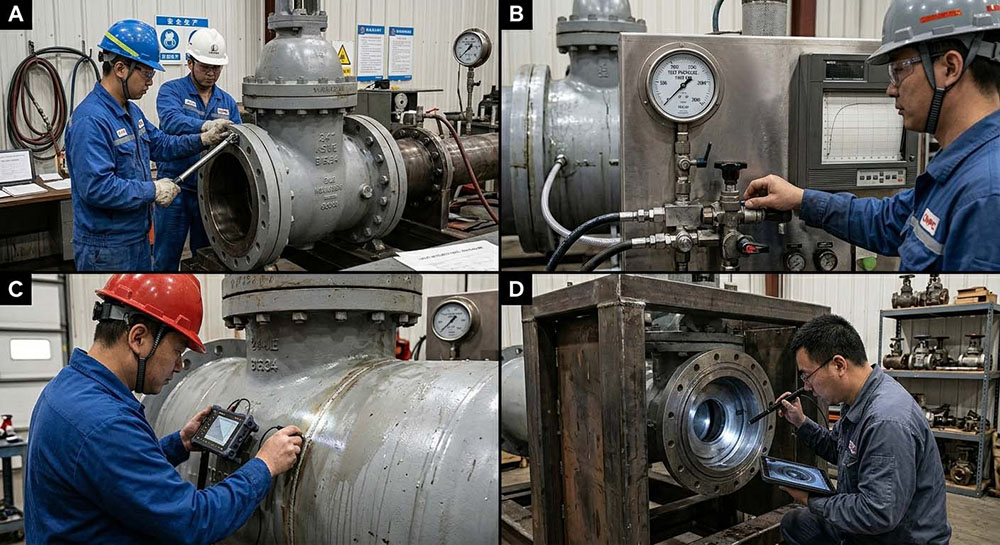
What we do: check the valve body, bonnet, bolts, and any other part that sees pressure. We’re trying to find casting defects – sand holes, shrinkage porosity, micro-cracks – plus any forging flaws.
Even a small defect can get worse under pressure or vibration. So we hold the test pressure, watch the gauge, and look for sweat on the casting. No pressure drop, no sweat – that’s our pass.
Core Test Parameters
| Item | Detail |
|---|---|
| Test pressure | At room temperature: 1.5 times the valve's PN rating. For example: PN16 gets 24 bar; PN25 gets 37.5 bar; PN40 gets 60 bar. |
| Test medium | Clean water – we can add a rust inhibitor. Water temperature kept between 5°C and 40°C. |
| Hold time | Depends on valve size. DN50 or smaller: at least 60 seconds. DN65 to DN200: at least 120 seconds. DN250 and larger: at least 300 seconds. |
| Acceptance criteria | No leakage visible on the body or at any connection. |
| No obvious deformation or damage. |
|
| The pressure gauge should not drop during the hold. |
What’s included in our hydrostatic shell test?
Traceable Report
Includes serial number, test pressure, hold time, operator name, date.
Standards We Meet
API 598, ISO 5208, EN 12266-1, GB/T 13927. Good for water treatment, HVAC, fire, general chemical export audits.
100% Tested, Not Sampled
Every shipping valve gets a hydrostatic shell test. Electronic record kept per unit.
Third-party Witness
SGS, BV, TÜV – just ask.
Size Coverages
DN15–DN2000 (1/2″–80″), PN6–PN420 (Class 150–2500). Custom pressure and special requirements accepted.
Technical Capabilities and Spec Sheets
Valve Prototyping & Sampling Workflow
Frequently Asked Questions
Test records are linked to each valve serial number and kept for 5 years. You can request a copy at any time.
Yes. We can set up a live video call (Zoom, Teams, or WeChat) so you watch the test in real time. We also include a free 30‑second short video (pressurisation, hold, gauge reading) with the report.
We provide internal test reports that strictly follow API 598 / ISO 5208, but they are not CNAS accredited. If you need an accredited report, we can arrange onsite witness from SGS, BV, or TÜV – they will issue their own report (extra cost and lead time).
In most cases, yes. Our report follows API 598 appendix, includes pressure curve, hold time, equipment ID, operator signature, and date – bilingual. It has been accepted by EPC contractors and end users in the Middle East, Southeast Asia, and Africa.
Our bench max is 200 bar (20 MPa). For Class 600, the 1.5× test pressure is about 155 bar – we can do it. For Class 900 and above, please provide valve details so we can confirm.
We mark the defect location (sand hole, crack, etc.) and return the valve to casting or welding for repair. After repair, we test again until it passes. You are not charged for repeated tests unless the failure is caused by a design change you requested.
Our test bench covers DN15 to DN600, maximum test pressure 200 bar (20 MPa). This covers your core range (DN50–300, PN16–40) with margin.
For regular orders, the hydrostatic shell test is part of our standard QC – no extra charge. If you need third‑party witness or individual video recording for each valve, there is a small additional fee.
Yes. Our report format follows API 598 appendix, includes test standard, pressure/time, equipment ID, operator signature, and date. It is bilingual (English + Chinese). Many EPCs and end users have accepted it.
Standard test uses clean water. For media that cannot contact water (e.g. oxygen service valves), we can use oil‑free dry air or nitrogen at the same pressure – but extra safety measures are required.
Yes. For example, if you need 1.6×PN or a specific pressure value, we follow the contract and note the custom pressure on the report.
No. At 1.5×PN as per standard, a qualified valve body only sees elastic deformation. No permanent damage. The valve can be used normally after testing.
| Stage | Procedure | Description |
|---|---|---|
| Before Production | PMI (Positive Material Identification) test | Raw material verification |
| In-Production | Dimensional checks | At critical machining stages |
| Post-Production | High-pressure hydrostatic shell test (1.5× rated pressure) Low-pressure air seat test (0.6 MPa) to verify shut-off Optional tests: helium leak test (ISO 15848), fire-safe test, or cryogenic test | Final assembly testing |
| Quality Inspection | Marking verification, coating/painting thickness measurement, and preparation of traceable test reports | Visual & documentary check |
All test records are archived for a minimum of 10 years and can be provided with each shipment. Or you can specify any third-party test institutions.
Our manufacturing facility is certified to ISO 9001:2015 for design, production, and after-sales service of industrial valves. Additionally, we hold ISO 14001:2015 (environmental management) and ISO 45001:2018 (occupational health and safety). All our ball valves for the European market comply with PED 2014/68/EU, and we can supply valves with ATEX certification for explosive atmospheres upon request. Our quality system is audited annually by third-party notified bodies.
Absolutely. For standard ball valves, we can offer off-the-shelf samples of common sizes (1/2″ to 4″) at a discounted price, with a refundable deposit that can be credited toward a future bulk order. For custom or larger sizes, we accept small trial orders (as few as 2–5 pieces) after a non-recurring engineering (NRE) fee is agreed. The NRE fee will be waived once the customer proceeds to a production order of 50 pieces or more.
We offer flexible payment terms based on order value and customer history. For standard orders: 30% deposit by T/T (wire transfer) with 70% balance before shipping. For larger or repeat customers, we can consider 20% deposit + 80% balance payment.
- For standard models, the minimum order quantity (MOQ) is usually 100 pieces per size. For sizes that are in stock, it takes 3 to 5 business days to ship after you place your order. Our usual lead time for making standard catalog valves that aren’t in stock is 15 to 25 business days after we get your order and approve the drawing.
- Custom models (with special materials, pressure classes, actuator mounting, custom logos, etc.): The minimum order quantity (MOQ) varies, so please get in touch with our sales team for a full quote. The lead time is usually 15 to 45 days, depending on how complicated the process is. Also, we offer a mixed-model consolidation service for distributors to help them deal with their inventory problems.