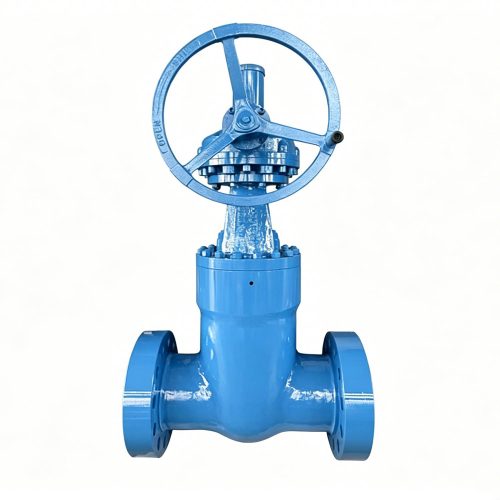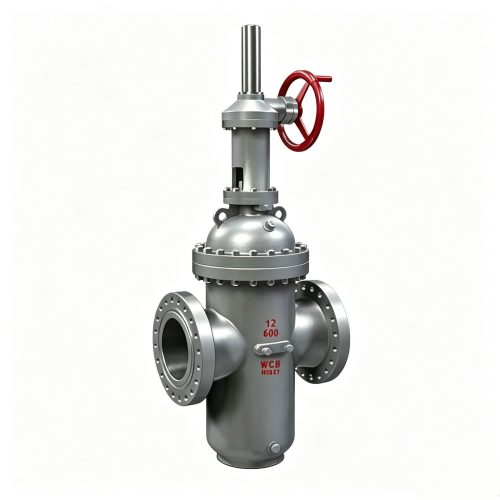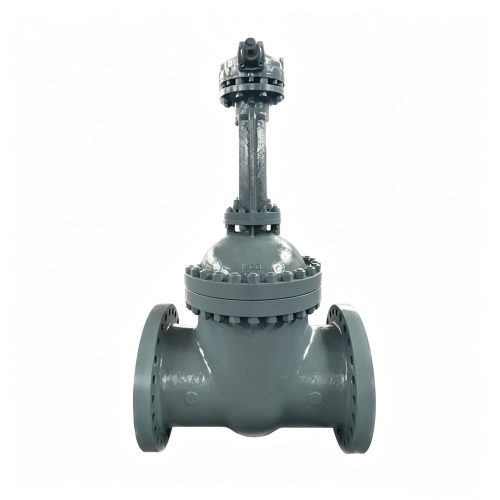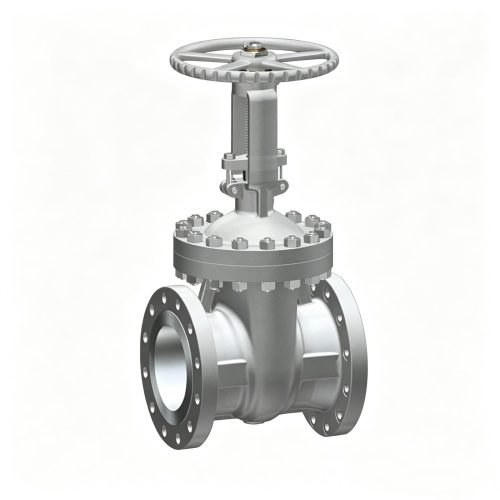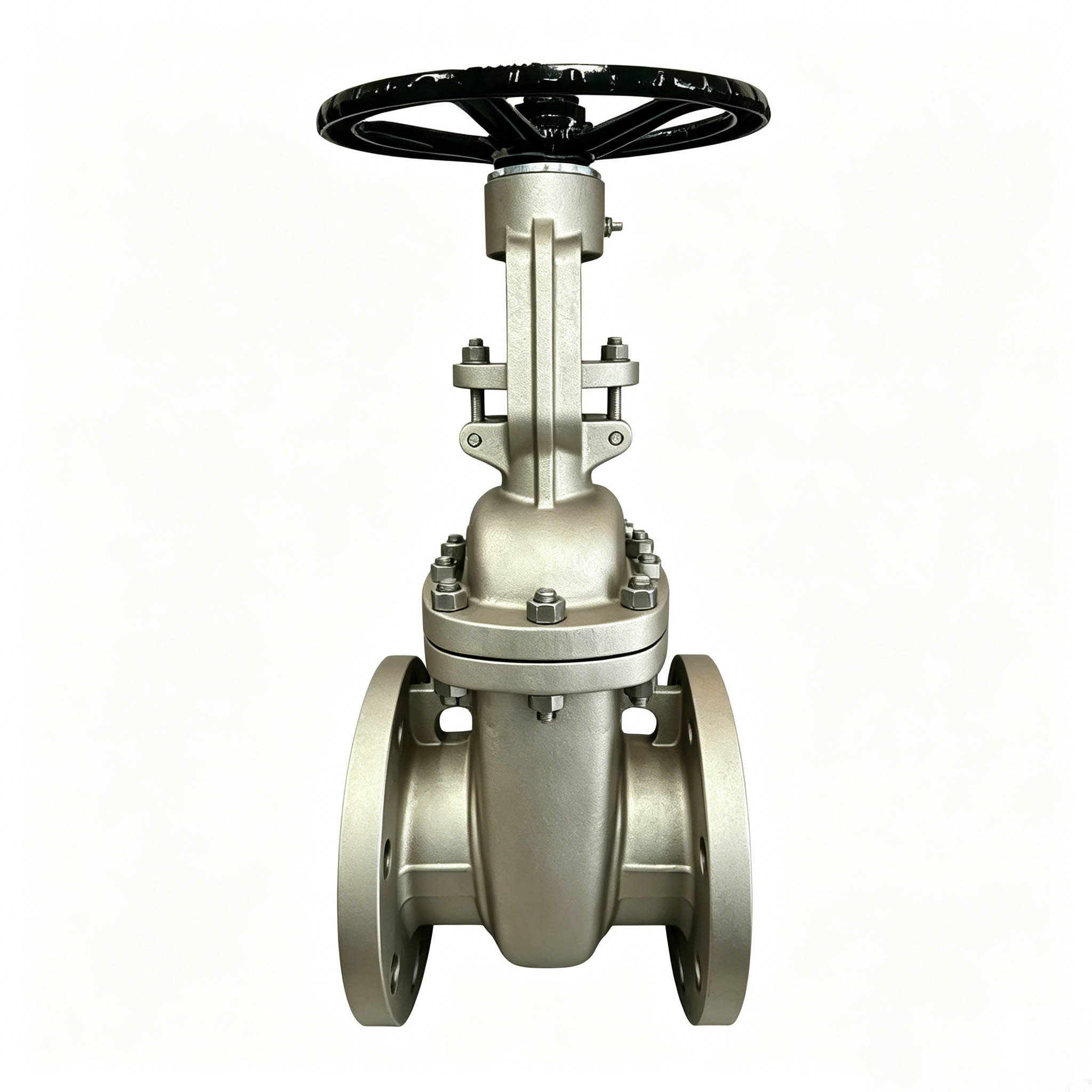




DN100 Class 150 C95800 Nickel Aluminum Bronze Gate Valve Handwheel Operated GT357502
The DN100 Class 150 gate valve is made from ASTM B148 C95800 nickel aluminum bronze. It’s built for seawater, brine, and marine systems – where corrosion kills ordinary valves. The cast bronze body has a bolted bonnet and a flexible wedge. That wedge keeps both seats sealing even when temperatures move up and down. On the seat and disc we put 13 percent chrome plus a Stellite 6 hardfacing. The stem is Monel K500, known for high strength and excellent resistance to saltwater attack. Connection is RF flanged to ASME B16.5. A handwheel operates the valve – simple and straightforward. Design follows MSS SP‑80, with full compliance to ASME B16.34, and each valve gets tested to API 598.
- Body: ASTM B148 C95800 nickel aluminum bronze, bolted bonnet
- Wedge: Flexible wedge, 13Cr and Stellite 6 hardfaced
- Stem: Monel K500 (ASTM B865)
- Connection: RF flanged, ASME B16.5
- Operation: Handwheel operated
- Temperature range: -29°C to +200°C for C95800 material (up to +425°C available upon request)
- Media: Seawater, brine, marine environment, dilute acids, non‑oxidizing chemicals
Product Attributes
| Valve Type | Gate Valve |
|---|---|
| Nominal Diameter (DN / NPS) | |
| Pressure Rating (PN / Class / JIS) | |
| Structure Type | |
| Stem Type | |
| Bonnet Type | |
| Wedge Type | |
| Body Material | |
| Trim Material | |
| Seat Construction | |
| Bore Type / Conduit | |
| End Connection | |
| Connection Standard | |
| Design Standard | |
| Operation / Actuation | |
| Suitable Media | |
| Application Industry | Desalination, Industrial Water Treatment, Marine, Water & Wastewater Treatment |
| Certifications | |
| OEM / Custom Service | Custom Body Material, Custom Coating / Surface Treatment, Custom Design / Engineering, Custom Logo / Branding, Custom Packaging, Custom Pressure Rating, ODM Service, OEM Service, Private Label |
Product Specifications
Product Usage
Seawater systems
Marine engineering
Desalination plants
Shipbuilding
Offshore platforms
Brine handling
Cooling water circuits with saline content
Dilute acid services
Non oxidizing chemicals
Industrial water treatment
Aquaculture
Ballast water lines
Firewater systems on ships
Low pressure corrosion resistant duties
Construction Characteristics
ASTM B148 C95800 nickel aluminum bronze body
Bolted bonnet
Flexible wedge design
Integral seat
Monel K500 stem
13 percent chrome with Stellite 6 hardfacing on seat and disc
RF flanged connection
ASME B16.5
Handwheel operated
Simple reliable operation
Designed to MSS SP 80
Fully compliant with ASME B16.34
Tested per API 598
Shell hydrostatic test
High pressure seat test
Low pressure air test
Bubble tight shut off
Rising stem OS&Y
Temperature range C95800 standard: -29°C to 200°C
Up to 425°C available upon request with design verification
Size 4 inch DN100
Class 150 rating
Certification
MSS SP 80 design standard
ASME B16.34 pressure temperature rating
API 598 test and inspection
ASME B16.5 flange dimension
ISO 9001 manufacturing
Material test report 3.1 available
NACE MR0175 compliance upon request subject to material verification
Body: ASTM B148 C95800 nickel aluminum bronze
Wedge / Disc: 13% chrome stainless steel with Stellite 6 hardfacing
Seat: Integral seat, Stellite 6 hardfaced
Stem: Monel K500 (ASTM B865)
Other materials can be customized upon request.
| Size (inch) | DN | L (mm) | H (mm) | W (mm) |
|---|---|---|---|---|
| 2" | 50 | 178 | Contact us | Contact us |
| 3" | 80 | 203 | Contact us | Contact us |
| 4" | 100 | 229 | Contact us | Contact us |
| 6" | 150 | 267 | Contact us | Contact us |
| 8" | 200 | 292 | Contact us | Contact us |
| 10" | 250 | 330 | Contact us | Contact us |
| 12" | 300 | 356 | Contact us | Contact us |
For other sizes you need, please contact us for detailed drawings.
Industrial Applications
Why Choose Our C95800 Nickel Aluminum Bronze Gate Valves?
1) CE (2014/68/EU), UKCA, API, ASME, ISO 9001 certified.
2) Material selection by H₂S, chlorides, and pH: We don’t guess from a “standard material” column. Each quotation includes a material compatibility overlay that cross‑references your fluid analysis (temperature, chlorides, partial pressure of CO₂/H₂S) against our 15‑year field failure database. You get a traceable justification for every wetted part.
3) Strict testing standards: You will receive test certificates of each C95800 Nickel Aluminum Bronze Gate Valve issued by our laboratory or any third-party institution that you have designated.
4) Emergency shut‑down torque: Each C95800 Nickel Aluminum Bronze Gate Valve is tested at maximum differential pressure in the closing direction. The measured break‑to‑open and reseat torque is laser‑etched on the body nameplate. When you size an actuator, you don’t multiply by 1.3 or 1.5 – you read the real number.
5) Anti‑static continuity verified per valve: We test every single assembled valve for electrical continuity across the ball/disk‑to‑stem‑to‑body path. Resistance <10Ω documented. No “representative sample” logic for ATEX/IECEx compliance.
6) Cavitation and flashing handled by geometry: For severe service trims (high‑recovery valves), we provide a cavitation index map and a recommended pressure drop staging for every C95800 Nickel Aluminum Bronze Gate Valve. You get a table of ∆P limits before choke flow and incipient damage.
7) Ten years of torque trend data back every design margin: When you order a valve, you receive an anonymized summary of identical service duty (fluid, temperature, cycle frequency) from our field archives, including observed wear patterns, packing re‑torque intervals, and seat degradation rate.
8) Documentation is not an extra – it’s a serial number’s companion: Enter your valve’s serial number on our portal: you get EN 10204 3.1 mill certificates, NDE reports (RT/PT/MT), hardness verification, and the original assembly torque log. No separate request form, no waiting.
9) Actuator mounting footprint kept stable across revisions: We do not change ISO 5211 mounting patterns without a 5‑year advance notice. Your automated valves bought today will accept the same actuator pad as valves bought five years ago – retrofit kits are never required.
10) Pressure test witness is your right, not a premium: Any valve order includes one free witness test (your inspector or a third party) at our facility, with a 48‑hour notice. No “witness fee”, no minimum quantity.
Frequently Asked Questions
No. Let me say that again: no. A gate valve is made for only two positions, fully open or fully closed. Do not ever try to use it as a throttle.
Why is that so bad? When you leave a gate valve partly open, the wedge sits right in the flow path. The fluid speeds up and starts eroding the sealing surfaces. That erosion has a name: wire drawing. Once the seat is damaged, the valve will leak internally and eventually fail completely.
There is another problem. A partially open gate valve vibrates. The wedge bangs against the seats every time the flow changes. That causes mechanical damage to both the wedge and the seats.
So if you need to adjust flow, use a globe valve or a ball valve with a V port trim. And make sure everyone on your operations team knows this rule. It will save you from replacing gate valves way ahead of time.
You need to answer four questions about your fluid. What is in it? How hot is it? How much pressure? Is it corrosive?
For ordinary oil, gas, and steam at high pressure and high temperature, carbon steel is your standard choice for the valve body.
If the fluid is corrosive, for example acids, seawater, or chemical solvents, you need stainless steel. CF8 or CF8M are common picks.
For really nasty corrosive conditions, or for temperatures above 550 degrees Celsius, or for cryogenic services down to minus 196 degrees, move up to alloy steels or special corrosion resistant alloys.
Now do not forget the trim. The trim means seat rings, stem, and disc. I have seen people pick a good body but cheap trim, and then the valve fails early. For clean water, an iron body with bronze trim is fine. But if your fluid has sand or other abrasive particles, you must specify hardened trim. Stellite overlay on the seats and disc will stop scoring and keep the valve tight for many years.
The big difference is how they seal. A wedge gate valve uses a tapered disc. The stem pushes it down into the seat, and the sealing force comes from that stem thrust. That works fine for oil, gas, and water at normal temperatures. A parallel slide gate valve uses two flat discs with a spring in between. When you close it, the line pressure pushes the downstream disc against its seat. The higher the pressure, the tighter the seal. So why does that matter? Because a parallel slide valve never gets thermal binding. If you have superheated steam above 400 degrees Celsius, or your system goes through a lot of heating and cooling cycles, the parallel slide design is much safer. The downside is cost. Wedge valves are cheaper and easier to fix. Parallel slide valves cost more, but they perform better at high temperatures.
I have seen gate valves fail in four typical ways.
First, leakage around the stem. The packing wears out from frequent operation, high pressure, or chemical attack. Check the packing gland once in a while and tighten it if it feels loose.
Second, leakage through the seat. That usually means the seat or the gate is damaged. High velocity flow, debris caught between the surfaces, or long term corrosion are the usual suspects. Do not use a gate valve for throttling, and try to keep the fluid clean.
Third, the stem snaps. This often happens because someone over torqued the valve, or because of corrosion in a salty environment, or metal fatigue from too many cycles. Use a torque wrench on large valves and lubricate the stem threads on rising stem designs.
Fourth, the gate gets stuck. Sediment builds up inside the valve body, especially in slurry service. Or the valve was installed crooked. The simple fix: cycle any valve that sits unused for a long time, and flush the line before you close it.
Here is the simple version. A full port gate valve has an opening that matches the inside diameter of your pipe. Fluid flows through as if the valve was not even there. Pressure drop is almost nothing, and you can send a pipeline pig right through for cleaning or inspection. A standard port valve has a smaller opening. That adds friction and you lose some pressure. You also cannot pass a pig. So when does it matter? If you are running a long transmission line, or your system is already close to its pressure limit, spend the extra money on full port. But if you just need an isolation valve on a process line, and you do not care about a little pressure drop and you never use pigs, a standard port valve will save you cash.
A rising stem valve, or OS&Y, literally moves the stem up when you open it. You can stand ten meters away and tell whether it is open or closed just by looking at how much stem is sticking out. The threads are outside the valve body, so they never touch the fluid. That means less corrosion and you can grease them easily. A non rising stem valve keeps the stem at the same height. You have to look at a separate indicator to know the position. Its threads are inside the valve, right in the fluid. Over time that leads to corrosion, dirt buildup, and wear. When would you use each one? For refineries, power plants, and any aboveground piping, rising stem is the standard. Fire protection systems require rising stem by NFPA rules. Non rising stem is for underground pits, spots with low headroom, and waterworks that follow AWWA standards.
Start with the metal seated type. It loves high temperatures, often over 400 degrees Celsius, and it handles abrasive fluids well. The problem shows up when your fluid contains sand or small pebbles. Those hard particles slowly grind down the metal sealing surfaces, and eventually you get leakage. Now look at the resilient seated valve. It uses a rubber lining that actually molds itself around small solid particles. That means a tight shutoff even if the fluid is a bit dirty. The downside is temperature. You usually cannot go above 70 degrees Celsius with a resilient seated valve. So which one do you pick? For clean fluids at room temperature or moderate heat where zero leakage is a must, go with resilient seated. For high temperature, high pressure, or fluids full of grit, choose metal seated. And one more thing: make sure the metal seating surfaces are hardened, for example with Stellite. That makes a big difference in how long the valve lasts.
The main standards you will encounter are API 600, API 6D, API 603, and ISO 10434. In practice, ISO 10434 is essentially equivalent to API 600 – both cover cast steel gate valves for refinery and chemical plant services. API 6D, on the other hand, is specifically tailored for long-distance pipeline applications, with added emphasis on double block & bleed (DB&B) and in-line sealing integrity. API 603 applies exclusively to stainless steel valves, suitable for Class 150~300 services involving corrosive media.
How to choose?
-
If your application requires pigging or double isolation, API 6D is the preferred choice.
-
If you prioritise shell safety under high temperature/pressure and full material traceability (typical in refinery duties), go with API 600.
-
For small-bore forged steel valves, refer to API 602.
Important note: All these standards reference ASME B16.34 (pressure‑temperature ratings), ASME B16.10 (face‑to‑face dimensions), and ASME B16.5/B16.47 (flange dimensions). However, each standard imposes its own additional requirements on shell wall thickness, leakage testing, and NDE procedures. If you are unsure which standard fits your specific service conditions, feel free to contact us – we offer free, tailored selection advice for your actual operating conditions.
| Stage | Procedure | Description |
|---|---|---|
| Before Production | PMI (Positive Material Identification) test | Raw material verification |
| In-Production | Dimensional checks | At critical machining stages |
| Post-Production | High-pressure hydrostatic shell test (1.5× rated pressure) Low-pressure air seat test (0.6 MPa) to verify shut-off Optional tests: helium leak test (ISO 15848), fire-safe test, or cryogenic test | Final assembly testing |
| Quality Inspection | Marking verification, coating/painting thickness measurement, and preparation of traceable test reports | Visual & documentary check |
All test records are archived for a minimum of 10 years and can be provided with each shipment. Or you can specify any third-party test institutions.
Our manufacturing facility is certified to ISO 9001:2015 for design, production, and after-sales service of industrial valves. Additionally, we hold ISO 14001:2015 (environmental management) and ISO 45001:2018 (occupational health and safety). All our ball valves for the European market comply with PED 2014/68/EU, and we can supply valves with ATEX certification for explosive atmospheres upon request. Our quality system is audited annually by third-party notified bodies.
Absolutely. For standard ball valves, we can offer off-the-shelf samples of common sizes (1/2″ to 4″) at a discounted price, with a refundable deposit that can be credited toward a future bulk order. For custom or larger sizes, we accept small trial orders (as few as 2–5 pieces) after a non-recurring engineering (NRE) fee is agreed. The NRE fee will be waived once the customer proceeds to a production order of 50 pieces or more.
We offer flexible payment terms based on order value and customer history. For standard orders: 30% deposit by T/T (wire transfer) with 70% balance before shipping. For larger or repeat customers, we can consider 20% deposit + 80% balance payment.
- For standard models, the minimum order quantity (MOQ) is usually 100 pieces per size. For sizes that are in stock, it takes 3 to 5 business days to ship after you place your order. Our usual lead time for making standard catalog valves that aren’t in stock is 15 to 25 business days after we get your order and approve the drawing.
- Custom models (with special materials, pressure classes, actuator mounting, custom logos, etc.): The minimum order quantity (MOQ) varies, so please get in touch with our sales team for a full quote. The lead time is usually 15 to 45 days, depending on how complicated the process is. Also, we offer a mixed-model consolidation service for distributors to help them deal with their inventory problems.
Looking for A Reliable Industrial Valve Manufacturer?
Our factory is equipped with a complete set of production facilities (three-axis, four-axis, and five-axis CNC machining centers, large vertical lathes, special process processing equipment, as well as fully automatic welding and sealing surface grinding equipment, etc.) and a testing laboratory, and implements a strict quality management system that has obtained ISO 9001 certification.
If you choose to cooperate with us, we will provide a complete set of certifications for each batch of valves: API 6D, API 600, API 607, CE/PED, TSG, ISO 15848-1 or other industry access certifications for specific fields. If you require us to provide testing and quality control, we will carry out non-destructive testing (NDT), material spectroscopy analysis, high-pressure gas tests, low-pressure airtight tests, torque tests, life cycle tests, and so on.
Each of our valves has a unique furnace batch number and serial number, which can be traced back to the raw material composition and assembly records. We also offer OEM/ODM services, and can customize special valves (design, materials, diameter, tolerance…) that meet the requirements of specific application scenarios for your special projects.
Leave An Inquiry
Please submit your inquiry via the form below or email [email protected]; Our team guarantees a response within 24 hours.