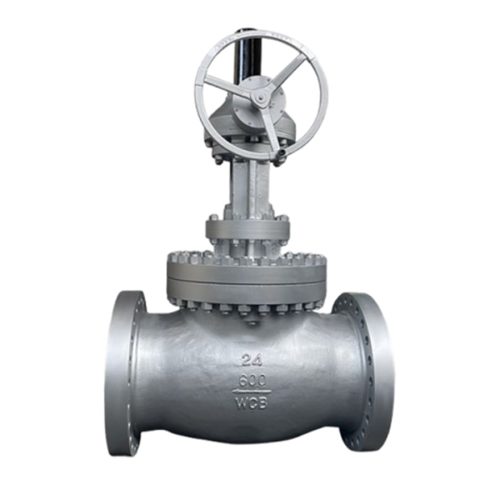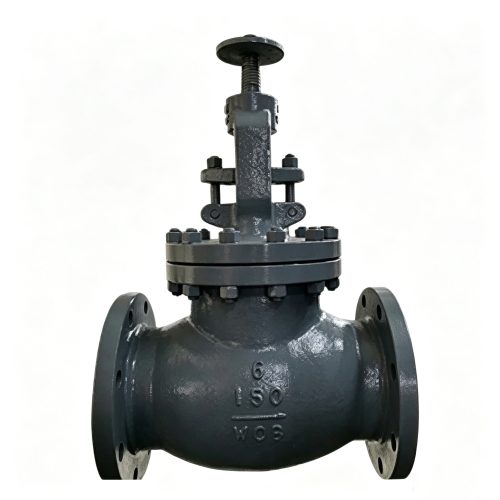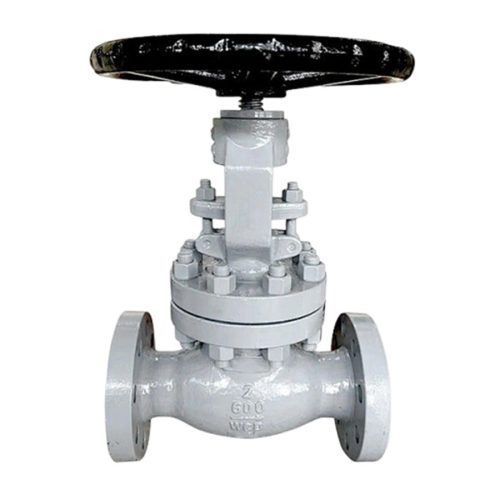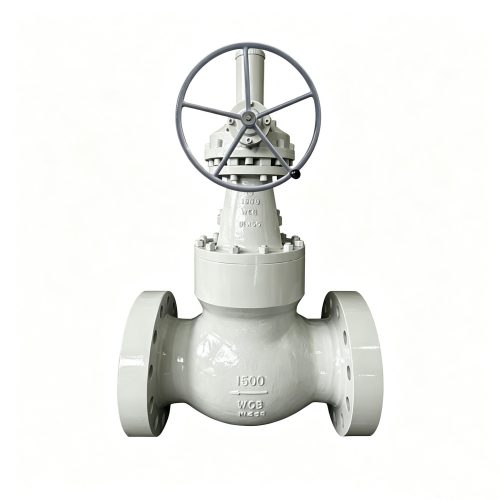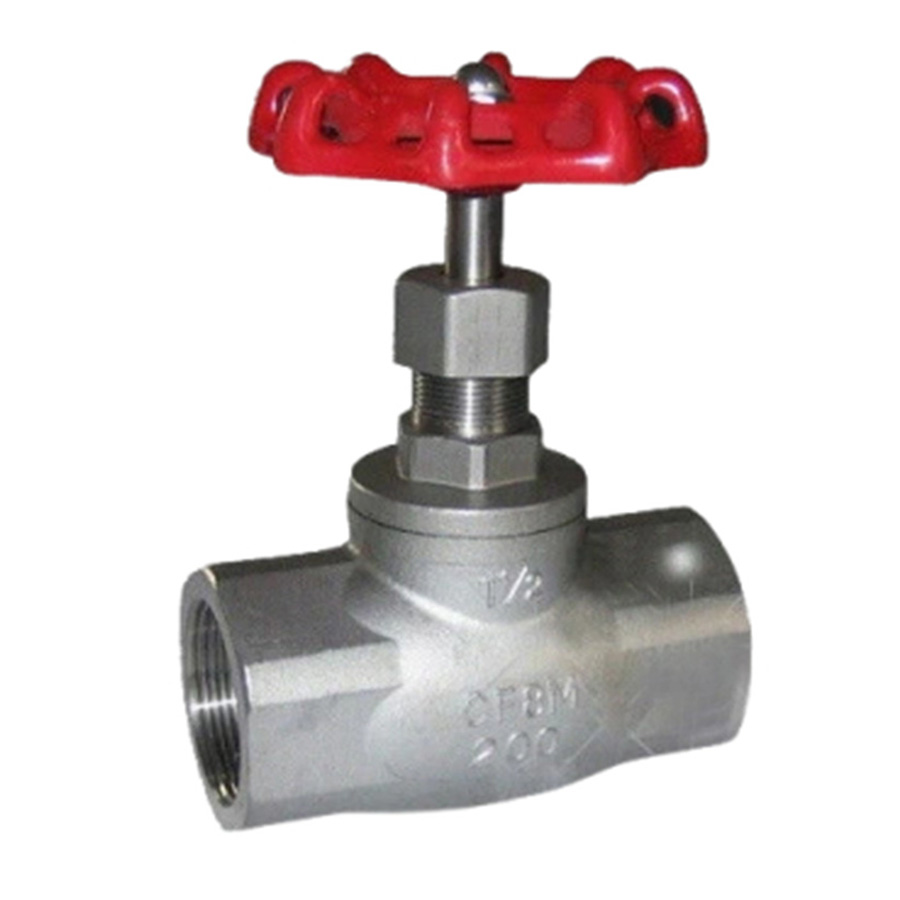




DN40 (1-1/2″) Class 200 ASTM A351 CF8M NPT Threaded Globe Valve GL029902
This 1-1/2″ (DN40) Class 200 globe valve is manufactured per API 602 standard. The body is stainless steel ASTM A351 CF8M, with matching stainless steel trim. End connections are NPT threaded. The valve has a bolted bonnet, outside screw and yoke (OS&Y) rising stem design, and is suitable for oil, gas, and water services. It offers reliable shut-off and corrosion resistance in general industrial applications.
Product Attributes
| Valve Type | Globe Valve |
|---|---|
| Nominal Diameter (DN / NPS) | |
| Body Pattern | |
| Disc / Plug Type | |
| Stem Type | |
| Stem Sealing | |
| Bonnet Type | |
| Body Material | |
| Trim Material | |
| Seat Construction | |
| Flow Direction | |
| End Connection | |
| Connection Standard | |
| Design Standard | |
| Operation / Actuation | |
| Suitable Media | |
| Gasket Material | |
| Application Industry | Chemical & Petrochemical, Energy & Power, Oil & Gas, Power Generation, Pulp & Paper |
| Certifications | |
| OEM / Custom Service | Custom Actuator Mounting, Custom Body Material, Custom Coating / Surface Treatment, Custom Degreasing / Cleaning, Custom Design / Engineering, Custom Documentation, Custom End Connections, Custom Face-to-Face Length, Custom Logo / Branding, Custom Packaging, Custom Pressure Rating, Custom Seat & Packing Material, Full Product Traceability, ODM Service, OEM Service, Private Label |
Product Specifications
Product Usage
-
Oil and gas processing
-
General industrial piping
-
Water treatment and distribution
-
Petrochemical facilities
-
Corrosive fluid handling (with CF8M material)
-
Instrumentation and utility lines
Construction Characteristics
-
Body material: ASTM A351 CF8M (stainless steel)
-
Bolted bonnet (BB) construction
-
OS&Y rising stem design
-
NPT threaded end connections
-
Gasket seal for body-bonnet joint
-
Corrosion-resistant stainless steel trim
-
Handwheel operation
-
Tight shut-off capability
-
Suitable for oil, gas, and water media
Certification
-
Design and Manufacture: API 602
-
End Connections: NPT (per ASME B1.20.1)
-
Pressure Rating: Class 200 LB
-
Body Material: ASTM A351 CF8M (stainless steel)
-
Body: ASTM A351 CF8M
-
Bonnet: ASTM A351 CF8M
-
Disc / Trim: Stainless Steel (matching CF8M)
-
Seat: Stainless Steel (integral or renewable, matching trim)
-
Stem: Stainless Steel
-
Gasket: Gasket Seal (typical for bolted bonnet)
-
Operation: Handwheel
Other materials can be customized upon request.
| Class | Connection | Size | L (mm) | H (Open) (mm) | W (mm) | WT (kg) |
|---|---|---|---|---|---|---|
| 200 | NPT | 1/2″ | 108 | 158 | 100 | 4.5 |
| NPT | 3/4″ | 117 | 163 | 100 | 6.9 | |
| NPT | 1″ | 127 | 193 | 125 | 9.8 | |
| NPT | 1-1/4″ | 140 | 250 | 160 | 13.5 | |
| NPT | 1-1/2″ | 165 | 250 | 160 | 19.5 | |
| NPT | 2″ | 203 | 291 | 180 | 28 | |
| 300 | NPT | 1/2″ | 152 | 158 | 100 | 4.8 |
| NPT | 3/4″ | 178 | 193 | 125 | 7.7 | |
| NPT | 1″ | 203 | 250 | 160 | 11 | |
| NPT | 1-1/4″ | 216 | 250 | 160 | 16.8 | |
| NPT | 1-1/2″ | 229 | 250 | 160 | 21.2 | |
| NPT | 2″ | 267 | 312 | 200 | 32.6 | |
| 600 | NPT | 1/2″ | 165 | 163 | 100 | 5.6 |
| NPT | 3/4″ | 190 | 193 | 125 | 7.8 | |
| NPT | 1″ | 216 | 250 | 160 | 12.5 | |
| NPT | 1-1/4″ | 229 | 250 | 160 | 17 | |
| NPT | 1-1/2″ | 241 | 250 | 160 | 23.5 | |
| NPT | 2″ | 292 | 312 | 200 | 38.8 |
Notes:
-
L = Face-to-face dimension for NPT ends (mm).
-
H (Open) = Overall height in fully open position (mm).
-
W = Diameter of handwheel (mm).
-
WT = Approximate weight for NPT end connection (kg).
Industrial Applications



Why Choose Our CF8M NPT Threaded Globe Valves?
Frequently Asked Questions
When you’re shopping for a globe valve manufacturer, the certifications they hold tell you a lot about their quality standards and what they’re capable of producing. Here’s a quick breakdown of what to look for:
On the design side, you want to see API 623 — that’s the heavy-duty bolted bonnet steel globe valve standard for petroleum refineries and related applications. You’ll also commonly see BS 1873 (the British standard for steel globe and check valves), along with ASME B16.34 which covers valves with flanged, threaded, and welding ends.
For testing, API 598 is the go-to standard for valve inspection and testing.
If you’re working with sour service (meaning H₂S environments), look for NACE MR0175 compliance — that’s non-negotiable for safety in those conditions.
For quality management, ISO 9001 is pretty much table stakes these days.
And if you’re shipping to Europe, you’ll need CE marking and PED compliance.
Just so you know, API 623 covers valves from NPS 2 through 24 (DN 50 to 600) and pressure classes 150 through 2500. A manufacturer that meets these standards has the know-how to produce valves with heavy wall sections and large stem diameters for the most demanding jobs out there.
Like any mechanical component, globe valves can run into issues over time. Here are the ones we see most often:
Leakage — This can happen at the body, the stem, or the seat. Usually it’s caused by wear on the sealing surfaces, aging gaskets, or a bent valve stem. The fix is pretty straightforward: replace the sealing surface or gasket, and check the stem for straightness.
Sticking — After a long period of use, the valve might get stuck and refuse to open or close properly. This is often due to scale buildup, debris accumulation, or not enough lubrication. A good cleaning and a proper lubrication schedule usually take care of it.
Stiff operation — If turning the handwheel feels harder than it should, you could be dealing with a bent stem, internal scaling, or poor lubrication again. Check the stem first and keep up with regular maintenance.
Stem or packing leakage — This one’s usually an easy fix. Just check the packing nut and gland bolts — they might have loosened up. Give them a snug (but not over-tight) turn and you’re good to go.
One golden rule: never, ever exceed the valve’s maximum pressure rating during operation. That’s a fast track to bigger problems.
In plain English, Cv is a number that tells you how much flow a valve can pass. More technically, it’s the number of US gallons per minute of 60°F water that can flow through a fully open valve with a 1 psi pressure drop. So if a valve has a Cv of 100, it means 100 gallons per minute of water will pass through with just 1 psi of pressure loss.
Here’s why this matters: Cv is the single most important number when you’re sizing a control valve. It tells you whether the valve is big enough to handle your required flow given the pressure drop you have available.
Now, a heads-up — globe valves have the lowest Cv per size compared to other valve types because of that S-shaped flow path we mentioned earlier. Just to give you a rough idea:
-
A 2-inch globe valve has a Cv around 30
-
A 4-inch globe valve is roughly 110
-
A 6-inch comes in around 210
-
And an 8-inch is about 340
If you want to do the math yourself, the basic formula for liquid flow is: Cv = Q × √(G / ΔP), where Q is flow rate in GPM, G is specific gravity (water = 1.0), and ΔP is pressure drop in psi. Not a fan of formulas? No problem — just tell us your conditions and we’ll help you size it.
Choosing the right globe valve comes down to asking yourself a few key questions about your system. Here’s what we usually walk our customers through:
First, what’s the job? Are you mainly throttling flow, or is it more of an on-off application? That’ll point you in the right direction. Next, you need to look at your flow rate and how much pressure drop your system can afford — that’s where the Cv value comes in (more on that in the next question). Then consider what’s actually flowing through the pipe. Is it clean water or steam? Oil or gas? Or is it something more aggressive? Just keep in mind that globe valves generally aren’t a good fit for slurries or fluids with suspended solids.
You’ll also need to think about your temperature and pressure — make sure they fall within the valve’s P-T rating per ASME B16.34. And don’t forget the physical stuff: do you need a straight pattern, a Y-pattern (which has lower flow resistance), or an angle pattern for a 90-degree turn? What about end connections — flanged, threaded, or welded? And which disc type makes sense for your level of throttling precision? Take all of this into account, and you’ll land on the right choice.
Yes, it absolutely does, and this is something you really don’t want to get wrong. Globe valves are unidirectional, which means they’re designed to allow flow in only one direction. On most valves, you’ll find an arrow cast right into the body — that’s your guide. If you can’t see it, you can also peek into one end of the valve and check whether you’re looking at the underside of the seat or above it. The standard setup is typically “low in, high out” — meaning the flow comes in from under the disc.
If you install it backwards, you’re asking for trouble. You’ll get increased stem packing wear, higher operating torque, potential seat leakage, and a shorter service life overall. So our advice? Always check that arrow before you bolt it into place. It takes two seconds and saves you a whole lot of headaches later.
This is probably one of the most common questions we get, and the short answer is: they’re built for completely different jobs. A gate valve is like an on-off switch — you either open it all the way or close it completely. If you try to use it for throttling, you’ll run into trouble fast because the partially open gate and seats get chewed up by high-velocity flow, causing what we call “wire drawing” erosion. In a matter of weeks or months, the valve could fail. A globe valve, on the other hand, is more like a dimmer switch — it’s happy to hold any position in between to regulate flow.
There are a few other differences worth noting. Gate valves have a straight-through bore so the pressure drop is very low, while globe valves have an S-shaped flow path that creates more resistance. Globe valves are also unidirectional — you’ll see an arrow on the body showing which way the flow should go — whereas gate valves work in either direction. And for the same size and pressure rating, globe valves tend to be heavier because they use more metal in the body. Design standards are different too: gate valves usually follow API 600, while globe valves are covered under API 623 or BS 1873.
If you’re looking for a valve that can do more than just turn flow on and off, a globe valve is probably what you need. It’s designed specifically for throttling — meaning you can adjust the flow rate by turning the handwheel and controlling how far the disc lifts off the seat. That vertical up-and-down movement gives you pretty precise control over the flow, which is why you’ll find these valves everywhere in steam systems, cooling water circuits, boiler feedwater lines, and chemical dosing applications. They’re also great for bypass lines and can handle high-pressure, high-temperature conditions without breaking a sweat. So if your system needs frequent flow adjustments, a globe valve is the way to go.
| Stage | Procedure | Description |
|---|---|---|
| Before Production | PMI (Positive Material Identification) test | Raw material verification |
| In-Production | Dimensional checks | At critical machining stages |
| Post-Production | High-pressure hydrostatic shell test (1.5× rated pressure) Low-pressure air seat test (0.6 MPa) to verify shut-off Optional tests: helium leak test (ISO 15848), fire-safe test, or cryogenic test | Final assembly testing |
| Quality Inspection | Marking verification, coating/painting thickness measurement, and preparation of traceable test reports | Visual & documentary check |
All test records are archived for a minimum of 10 years and can be provided with each shipment. Or you can specify any third-party test institutions.
Our manufacturing facility is certified to ISO 9001:2015 for design, production, and after-sales service of industrial valves. Additionally, we hold ISO 14001:2015 (environmental management) and ISO 45001:2018 (occupational health and safety). All our ball valves for the European market comply with PED 2014/68/EU, and we can supply valves with ATEX certification for explosive atmospheres upon request. Our quality system is audited annually by third-party notified bodies.
Absolutely. For standard ball valves, we can offer off-the-shelf samples of common sizes (1/2″ to 4″) at a discounted price, with a refundable deposit that can be credited toward a future bulk order. For custom or larger sizes, we accept small trial orders (as few as 2–5 pieces) after a non-recurring engineering (NRE) fee is agreed. The NRE fee will be waived once the customer proceeds to a production order of 50 pieces or more.
We offer flexible payment terms based on order value and customer history. For standard orders: 30% deposit by T/T (wire transfer) with 70% balance before shipping. For larger or repeat customers, we can consider 20% deposit + 80% balance payment.
- For standard models, the minimum order quantity (MOQ) is usually 100 pieces per size. For sizes that are in stock, it takes 3 to 5 business days to ship after you place your order. Our usual lead time for making standard catalog valves that aren’t in stock is 15 to 25 business days after we get your order and approve the drawing.
- Custom models (with special materials, pressure classes, actuator mounting, custom logos, etc.): The minimum order quantity (MOQ) varies, so please get in touch with our sales team for a full quote. The lead time is usually 15 to 45 days, depending on how complicated the process is. Also, we offer a mixed-model consolidation service for distributors to help them deal with their inventory problems.
Looking for A Reliable Industrial Valve Manufacturer?
Our factory is equipped with a complete set of production facilities (three-axis, four-axis, and five-axis CNC machining centers, large vertical lathes, special process processing equipment, as well as fully automatic welding and sealing surface grinding equipment, etc.) and a testing laboratory, and implements a strict quality management system that has obtained ISO 9001 certification.
If you choose to cooperate with us, we will provide a complete set of certifications for each batch of valves: API 6D, API 600, API 607, CE/PED, TSG, ISO 15848-1 or other industry access certifications for specific fields. If you require us to provide testing and quality control, we will carry out non-destructive testing (NDT), material spectroscopy analysis, high-pressure gas tests, low-pressure airtight tests, torque tests, life cycle tests, and so on.
Each of our valves has a unique furnace batch number and serial number, which can be traced back to the raw material composition and assembly records. We also offer OEM/ODM services, and can customize special valves (design, materials, diameter, tolerance…) that meet the requirements of specific application scenarios for your special projects.
Leave An Inquiry
Please submit your inquiry via the form below or email [email protected]; Our team guarantees a response within 24 hours.